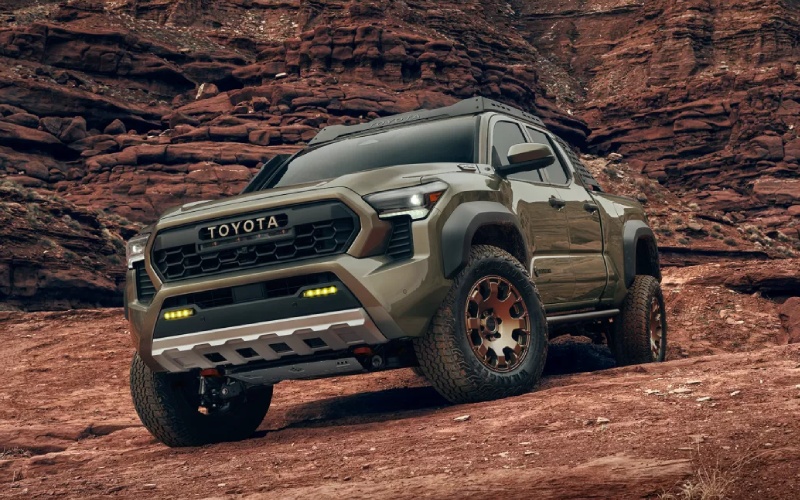
Toyota of Kirkland - Which midsize truck has smarter off-road tech for Redmond, WA trails — 2026 Toyota Tacoma or 2026 Chevrolet Colorado?
When shoppers ask which midsize truck delivers smarter off-road technology for Redmond trail days and after-work forest road runs, the conversation often centers on the 2026 Toyota Tacoma and the 2026 Chevrolet Colorado. Both are seriously capable. But the way each truck assembles its hardware and software — and how those tools help you on steep, wet, and rutted terrain common in our area — is where the differences appear. Below, we unpack the systems that matter most when you leave pavement, then connect them to everyday benefits, like backing a trailer at Marymoor or threading through tight lots near Lake Sammamish trailheads.
Trail-facing cameras, traction aids, and real-time control
Toyota equips the Tacoma with an available 3D Multi-Terrain Monitor (MTM) that lets you toggle between front, side, and rear views and even see the ground below the truck — a perspective that proves invaluable when rocks, roots, and washouts force you to pick a narrow line. Crawl Control (CRAWL) functions like low-speed cruise control for the trail, modulating throttle and brakes so you can concentrate on steering. Add the Stabilizer Disconnect Mechanism (SDM), and Tacoma increases front articulation at the touch of a button for better tire contact on uneven surfaces. Chevrolet counters with Colorado’s strong off-road suite: Off-Road and Terrain drive modes, Hill Descent Control, and available underbody camera views that help spot obstacles. ZR2’s Multimatic® DSSV dampers and factory lift are well-regarded for desert and high-speed work. Both trucks provide useful information and traction support, but Tacoma’s MTM ground view and CRAWL make slow, technical moves more repeatable and less stressful when it’s slick or deeply rutted.
On the trail, fatigue is often the enemy of good decisions. Tacoma’s available IsoDynamic Performance front seats on TRD Pro use a unique dampening design to limit occupant body movement over choppy ground. That means you arrive fresher — and better able to focus on the last mile of rock or root garden. Colorado’s cabins are comfortable, and ZR2’s suspension takes big hits in stride, but the Tacoma’s seat tech is unusually thoughtful for all-day trail sessions.
Power delivery, gearing, and the right tools for Pacific Northwest terrain
Torque you can apply smoothly at very low speeds is priceless on our slick, off-camber climbs. With the available i-FORCE MAX hybrid, Tacoma delivers up to 465 lb.-ft. of torque and quick response that helps you tiptoe up loose gravel or greasy clay without spinning. The available 6-speed intelligent Manual Transmission (iMT) on select Tacoma grades gives skilled drivers precise control on descents and switchbacks, an advantage on narrow single-lane tracks or when easing over ledges. Colorado’s 2.7L TurboMax engine offers 430 lb.-ft. of torque and pairs with an 8-speed automatic only — a stout, simple combo that works well in most conditions. If you prefer hybrid torque with a manual option for the technical bits, Tacoma is the rare midsize truck that checks both boxes.
Beyond propulsion, trail utility matters. Tacoma’s available 2400W AC power supply in the bed can charge tool batteries, run a work light while you fix a bike, or handle campsite gear without a separate generator. It’s a quiet advantage that shows up between the fun parts of a trip — and keeps you organized.
Backing up, lining up, and getting unstuck
Backing a trailer down a narrow, dark ramp or into a small campsite is where tech can save your evening. Tacoma’s available Trailer Backup Guide with Straight Path Assist uses steering inputs and guidance to help keep things aligned, even with limited visibility. The available Blind Spot Monitor (BSM) can extend detection when a trailer is recognized. Colorado offers a trailering app and up to 10 camera views on select configurations, plus helpful hitch guidance. Both assist with visibility; Tacoma goes further by actively helping you correct jackknife tendencies in tight spots.
Who benefits most from each truck’s approach?
If your trail mix leans toward technical, slow-speed routes — think rutted spurs above Snoqualmie or woody loops east of Redmond, WA — the Tacoma’s blend of CRAWL, SDM, and 3D MTM simplifies the tricky parts. You get a stable, repeatable process for climbing and descending without drama. If your off-road habit favors faster, open terrain with long whoops and higher approach speeds, Colorado’s ZR2 chassis tuning shines. Either way, understanding how you like to explore will guide your best choice.
Frequently Asked Questions:
Does the 3D Multi-Terrain Monitor replace a spotter on tight trails?
No camera fully replaces a trained spotter, but Tacoma’s available 3D MTM adds ground and side views that reduce guesswork when you cannot see your front tires or the drop just off the rocker. It’s especially helpful in rain-soaked, low-visibility conditions.
Is Crawl Control useful on wet boat ramps, or just on dirt?
CRAWL is tuned for off-road use, but its low-speed throttle and brake modulation can help you move smoothly without surging on slick surfaces. For ramps, Tacoma’s Trailer Backup Guide with Straight Path Assist and strong low-end torque are the bigger daily helpers.
Can Colorado’s underbody cameras show the ground directly below the truck like Tacoma’s 3D MTM?
Colorado offers available underbody camera views that are very useful for spotting obstacles under the chassis. Tacoma’s MTM adds a specific ground view mode that shows terrain immediately in front of and below the vehicle to aid precise tire placement.
Which truck offers a manual transmission for better low-speed control?
Tacoma offers an available 6-speed intelligent Manual Transmission (iMT) on select grades; Colorado uses an 8-speed automatic across the lineup.
What about cabin comfort on long, rough approaches?
Tacoma’s available IsoDynamic Performance front seats on TRD Pro help limit body movement over repeated impacts, which can reduce fatigue. Colorado’s cabins are comfortable and well-equipped; both trucks offer supportive seating for long days.
Ultimately, both trucks have strong off-road toolkits. If you want hybrid torque, a manual option, and camera views tailored to technical driving, Tacoma makes the choice easy. If you prefer a single, high-output gas engine and a chassis dialed for higher-speed off-road runs, Colorado is a solid fit. For personalized guidance and local trail insight, Toyota of Kirkland — serving Bellevue, Redmond, and Seattle — is happy to help you map truck features to how and where you drive.
Request more 2026 Toyota Tacoma information
Categories:
Toyota Tacoma